Extrusion Blow Molding
Production of hollow products: from bottles and jars to canisters and barrels
Up to 20 L
~1 min
2 models
Machine for products up to 1 L
Vials, jars, bottles
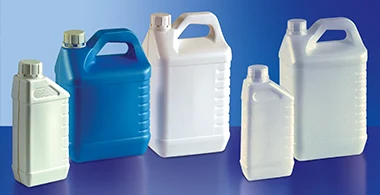
Machine for products up to 20 L
Canisters, tanks, large containers
Production process
Extrusion and preform blowing

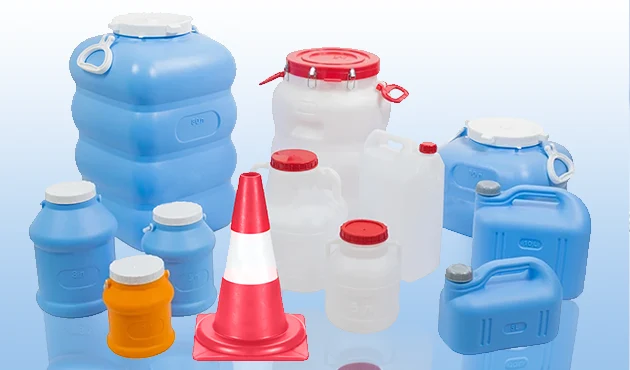
Finished products
From small bottles to barrels
About the extrusion blow molding technology
Extrusion blow molding is a highly efficient method for manufacturing hollow products from thermoplastics that combines two processes: extrusion and blowing (forming with pressurized air).
How does it work?
In extrusion blow molding, molten plastic is extruded into a hollow tube (a preform) called a parison. The process begins by loading polymer pellets into the extruder where they are heated to melting temperature and mixed by the screw to form a uniform viscous mass. This melt is extruded through an annular die, forming a parison — a tubular preform with a wall thickness corresponding to the final product.
The preform is then enclosed in a cooled metal mold. It is important that the parison has the right temperature — hot enough to deform but not so hot that it sags under its own weight. The mold consists of two halves that close around the parison, pinching the top and bottom to create a sealed cavity.
Next comes the actual blowing. Compressed air (typically 5–10 bar) is introduced through a special nozzle into the preform, inflating it to the mold size. Under air pressure, the plastic stretches and presses against the mold walls, precisely reproducing every detail of the mold surface — reliefs, threads, inscriptions, etc.
Upon contact of the inflated preform with the cold mold, the plastic cools and solidifies quickly. The mold is made of a metal with high thermal conductivity (aluminum or steel) and often has a cooling system to speed up the process. Once the product has sufficient rigidity, the mold opens and the part is ejected. Excess parison material (pinched top and bottom) is removed in subsequent operations.
Production process specifics
Setting up the production cycle is lengthy — more than 1 day. This is due to the need for precise tuning of many parameters: melt temperature, extrusion speed, parison thickness, cooling time, blow pressure, and others. Each product and material requires individual adjustment. The technologist must achieve an optimal balance so that the product has uniform wall thickness, no defects (voids, warping, unevenness), and meets all customer requirements.
However, once tuned, the production time of a single item is about 1 minute, providing high productivity. Therefore, extrusion blow molding is used for medium- and large-scale production. The technology is not suitable for one-off items due to the lengthy setup, but it is ideal for batches ranging from thousands to millions of products. Automation allows operation with minimal operator involvement after setup.
What can be produced?
Extrusion blow molding is used to manufacture a wide range of hollow products of various purposes and volumes. The technology enables products with uniform wall thickness that are hermetic and resistant to mechanical loads.
Cosmetics and Perfumery
Jars and bottles for cosmetics in various shapes and designs, from mini samples to large family packages
- Shampoo and shower gel bottles
- Cream jars
- Dispensers and sprayers
Food industry
Containers for food products with high requirements for hygiene and material safety
- Beverage bottles
- Dairy product jars
- Oil and sauce containers
Household chemicals
Containers for detergents, laundry liquids, fabric softeners with resistance to aggressive chemicals
- Detergent bottles
- Canisters for liquids
- Spray bottles
Technical fluids
Canisters and tanks for technical fluids, lubricants, antifreeze with increased strength
- 5–20 L canisters for oils
- Windshield washer tanks
- Antifreeze containers
Automotive industry
Vehicle components with high strength and resistance to fuels and lubricants
- Fuel tanks
- Air ducts
- Hoses and fittings
Road equipment
Traffic safety elements with high visibility and weather resistance
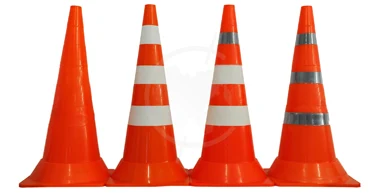
- Traffic cones
- Delineator posts
- Barrier elements
Materials for extrusion blow molding
Products are manufactured from polyethylene, polypropylene, and certain types of thermoplastic elastomers. Each material has unique properties that determine its application.
Polyethylene (PE)
The most popular material for blow molding. Excellent chemical resistance, flexibility, and low cost.
- HDPE for rigid products
- LDPE for squeezable bottles
- Resistance to acids and alkalis
- Food-safe
Polypropylene (PP)
High-strength material with excellent heat resistance. Stiffer than polyethylene and withstands higher temperatures.
- High heat resistance (up to 100°C)
- High product stiffness
- Sterilizable
- Excellent impact strength
Thermoplastic elastomers (TPE)
Combine rubber-like elasticity with thermoplastic processability. For special applications.
- Soft-touch
- High elasticity
- Resistance to oils and fats
- Possibility of multi-layer blow molding
Our extrusion blow molding machines
We offer two extrusion blow molding machines: for products up to 1 liter and up to 20 liters. Both machines are equipped with modern control systems ensuring stable quality and high productivity.
Machine for products up to 1 L
Compact and versatile
Ideal for manufacturing:
- Cosmetic and perfumery bottles
- Beverage and food bottles
- Household chemical containers
- Medical and pharmaceutical packaging
Advantages:
- • Compact equipment size
- • Low energy consumption
- • Fast changeover to another product
- • High dosing accuracy
Machine for products up to 20 L
Powerful and productive
Ideal for manufacturing:
- Canisters for technical fluids and oils
- Barrels for water and food liquids
- Tanks for automotive applications
- Industrial containers
Advantages:
- • High productivity
- • Ability to produce thick-walled products
- • Powerful extrusion system
- • Multi-layer blow molding for barrier properties
Technology advantages
High productivity
Production cycle about 1 minute when tuned
Seamless products
No seams ensures tightness and strength
Cost efficiency
Low production cost for medium and large series
Design possibilities
Variety of shapes, colors, embossed surfaces
Product strength
Uniform wall thickness ensures high strength
Multi-layer capability
Ability to create multi-layer products with barrier properties
Замовити розрахунок
Маєте питання? Зв'яжіться з нами сьогодні